
Published on Wed, 2018-11-21 10:29
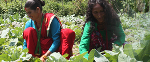
Food is the axis of the civil society report on the SDGs in Nepal, where “transnational corporations are grabbing land, monopolizing seeds and food markets, and marginalizing small holder farmers more”. As visible evidence, “now in Nepal packed foods are common not only in the urban townships but also in remote and hard to reach areas, replacing indigenous food consumption patterns. Farmers rely heavily on seed markets rather than preserving their own seeds, which was common practices in Nepal even a few years back.” Food quality is degrading as farmers are using chemical pesticides and fertilizers. This creates health problems, and even when food availability has improved, the supply is inadequate to meet the surging food demand. Cereal import dependency has been rising, while Nepal's capacity to export food has been falling. This can also be linked with the huge out-migration among youth for work in foreign lands in the absence of opportunities in the country. |
Published on Wed, 2018-11-21 10:26
In the United Kingdom, a consultation process coordinated by the UK network of Stakeholders for Sustainable Development (UKSSD) concludes that “inequality is projected to rise in the coming years”. Paradoxically, the unemployment rate is reaching an historical low, but “at the same time, tax and social security cuts introduced since 2012 have had a particularly severe effect on people on lower incomes. Black and ethnic minority households, families with at least one disabled member, and lone parents (who are overwhelmingly women) have suffered disproportionately”. A member of the network, Just Fair, led the drafting of the civil society chapter on SDG 10 on the reduction of inequality at the national level and highlights the fact that, thanks to the Equality Act of 2010, “authorities gather and transparently report useful disaggregated data”. Yet, successive governments have failed to implement this Act. The duty is in force in Scotland since April 2018, Wales has the power to follow suit, some councils are voluntarily implementing it and 78 Members of Parliament from five different parties are calling on the government to bring the duty into effect. |
Published on Fri, 2018-11-16 14:52
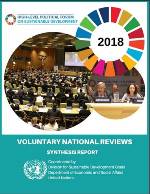
The third annual Synthesis Report of the voluntary national reviews (VNRs) is now available. The report was coordinated by the Division for Sustainable Development Goals of the United Nations Department of Economic and Social Affairs. The third annual Synthesis Report of the voluntary national reviews (VNRs) is now available. The 'Voluntary National Reviews 2018: Synthesis Report' synthesizes some of the findings of the 46 VNRs presented at the HLPF in July 2018. The report was coordinated by the Division for Sustainable Development Goals of the United Nations Department of Economic and Social Affairs. |
Published on Fri, 2018-11-16 06:56
A strong and dynamic World Health Organisation (WHO) is critical for the achievement of the SDGs, especially SDG 3 on health and well-being. The WHO constitution mandates the organization "to act as the directing and co-ordinating authority on international health work”. However, its ability to fulfil this mandate is circumscribed by the nature of its financial resources. WHO’s biennial budget for 2018-2019 is US$ 4.42 billion, 2 just over a quarter of the total sales of the top-selling medicine Humira (Adalimumab) in 2016 (US$ 16.08 billion). In part this is because many of the organization’s donors share the view that WHO may not need a huge budget to carry out its constitutional mandate, which mainly consists of setting norms and standards in the area of public health. However, a large part of the organization’s spending in 2016-2017 went to activities related to service delivery rather than to norms and standard setting. For example, US$ 1.16 billion (25.67%) was spent on its polio eradication programme. |
Published on Fri, 2018-11-16 06:43
Widespread privatization of public goods is systematically eliminating human rights protections and further marginalising the interests of low-income earners and those living in poverty, a United Nations human rights expert has said. In a recent report to the UN General Assembly, the Special Rapporteur on extreme poverty and human rights, Mr Philip Alston (from Australia), said that existing human rights accountability mechanisms are clearly inadequate for dealing with the challenges presented by large-scale and widespread privatization. "Privatizing the provision of criminal justice, social protection, prisons, education, basic healthcare and other essential public goods cannot be done at the expense of throwing rights protections out of the window," Mr Alston said. |
SUSCRIBE TO OUR NEWSLETTER
 |

